
A COMPLETE GUIDE
What Is an Esports Arena? A Complete Guide for Schools and Colleges
An esports arena is a dedicated, networked space built for competitive gaming, live broadcasting and digital skills teaching. The term covers everything from a repurposed classroom with a dozen upgraded PCs to a full auditorium with broadcast galleries and racing simulators, but the good ones share the same foundations: purpose-built hardware, furniture designed for long sessions, and a network that can handle the whole room running flat out at once.
People often use “gaming room” and “esports arena” interchangeably, but there’s a real difference in what the space is built to do. A gaming room is usually a handful of consoles or general-purpose PCs for casual play. An esports arena is built around competition, teaching and broadcast from the start, with the networking, furniture and management software to support a full class or team running structured sessions.
Why Institutions Are Building Them
RECRUITMENT AND OPEN DAYS
A dedicated esports arena is a genuine draw on open days. Institutions with a visible, well-equipped facility have an edge over schools relying on a standard ICT suite, especially with prospective students who already take esports seriously. It gives parents and prospective students something to see and stand in, not just a course description to read, and that pull is exactly what makes a facility worth showing off on the tour.
REACHING THOSE WHO DON’T ENGAGE WITH TRADITIONAL SPORT
This is the strongest-evidenced benefit institutions report. Coleg Cambria’s Assistant Principal for Technical Studies has linked its arena directly to widening access for learners who are disengaged or at risk of becoming NEET. Plymouth Argyle FC’s Babcock Esports Arena, delivered with City College Plymouth, was built explicitly to reach young people outside traditional sport. Esports gives these students the same teamwork, communication and pressure-management skills as a sports team, in a format some of them will actually turn up for.
CURRICULUM ALIGNMENT
Esports now sits inside formal qualifications. The Pearson BTEC in Esports covers event management, video production, sports psychology and network administration. A dedicated arena is what makes it possible to teach those modules with real broadcast equipment and a genuine competition space.
It’s worth setting expectations honestly here too: only a tiny fraction of students, well under 1%, will ever go pro. The bigger opportunity is everything built around the professional scene: event management, team coaching, shoutcasting and presenting, data analysis and digital literacy. A BTEC in Esports prepares students for that whole ecosystem, not just the long odds of a pro contract.
VENUE HIRE AND COMMUNITY INCOME
Some institutions offset their investment by hiring the space out for community tournaments, holiday camps or corporate bookings once timetabled sessions finish. It’s a genuine revenue stream. Treat any income projection as illustrative, since it depends on local demand and on having staff available to run and supervise sessions outside term time, a real operational cost most projections leave out.
WHAT GOES INTO AN ESPORTS ARENA?
HIGH PERFORMANCE PCS
Standard classroom computers can’t handle competitive gaming or streaming workloads. An arena needs high-specification builds with proper thermal management, paired with high-refresh-rate monitors, mechanical keyboards and precision mice. Every system is stress-tested and benchmarked before it leaves our workshop, so it arrives ready to run.
SPECIALIST FURNITURE
Ergonomics and durability matter more than they look like they would. Our ES2 desk is built for continuous daily use, with an integrated monitor mount and a raised plinth to display the PC, with the ESX suited to different room layouts. Adjustable, DDA-compliant sit/stand desks cover accessibility, paired with proper gaming chairs designed for posture over long sessions.
BRANDING AND ATMOSPHERE
A well-built arena feels different from a classroom the moment you walk in. Custom signage, team branding and a genuine “wow factor” centrepiece give students a sense of ownership and identity, the same instinct that makes a team want to defend its own pitch. It’s a small part of the spec that does a lot of the work in making a space feel like it belongs to the students using it.
CASTING AND STREAMING SETUPS
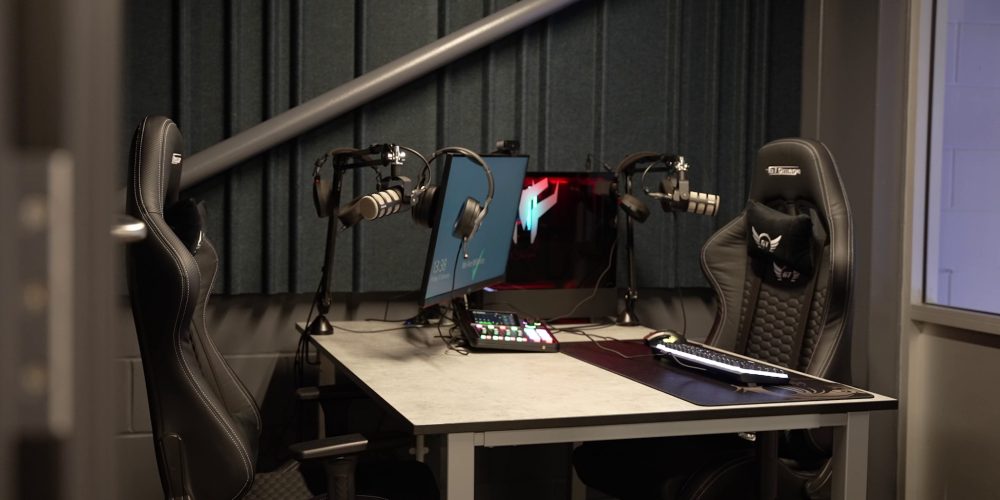
Cameras, capture cards and audio built in from the start let students broadcast and commentate matches as part of the curriculum, not as an afterthought bolted on later.
ARENA MANAGEMENT SOFTWARE
Manually patching thirty machines by hand isn’t realistic for a school IT team. We integrate ggCircuit’s platform, using ggLeap for session and permission control and ggRock for diskless boot, so game updates roll out centrally overnight, content filters apply automatically, and staff can manage every machine in the room from one screen.
ROOM DESIGN AND NETWORKING
Esports needs low latency and stable bandwidth. That means hardwired Cat 6 cabling and, ideally, a separate VLAN so a room running flat out doesn’t choke the rest of the school’s network. Electrical work should meet BS 7671 wiring regulations as standard.
How an Esports Arena Gets Built
1. Consultation and design.
We start with your curriculum goals, room dimensions and budget, and design your solution from scratch, including 3D renders for easy stakeholder approval.
2. Electrical work and room prep.
Certified contractors handle any wiring and room modifications to current UK safety standards before equipment arrives.
3. Build and install.
Custom PCs, furniture and any racing sims are manufactured and fully installed.
4. Software setup and testing.
We configure the management software and boot servers, then stress-test the network to confirm it holds up with every machine running at once.
5. Training and support.
Staff training, BTEC resources and ongoing technical support, because most arenas need hands-on help in the first term as staff and students settle in.
OUR ESPORTS ARENAS ACROSS THE UK
WILTSHIRE COLLEGE
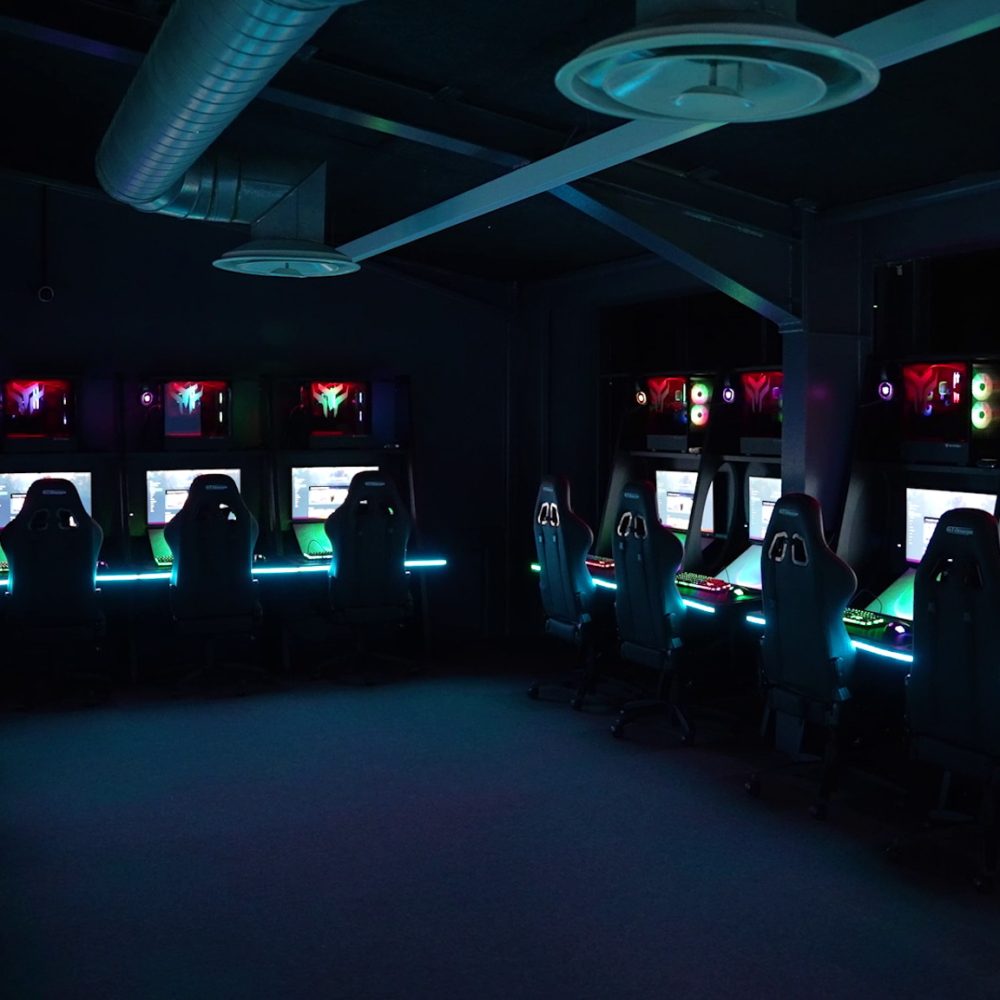
Built into the college’s Arc Theatre as part of a £2.5m regional skills investment, the arena combines 10 competitive gaming stations with a further 17 linked stations in a separate teaching area, plus two dedicated shoutcasting rooms and broadcast capability with four PTZ cameras. It’s one of the largest and most broadcast-capable esports facilities in UK further education.
Mary Immaculate SCHOOL
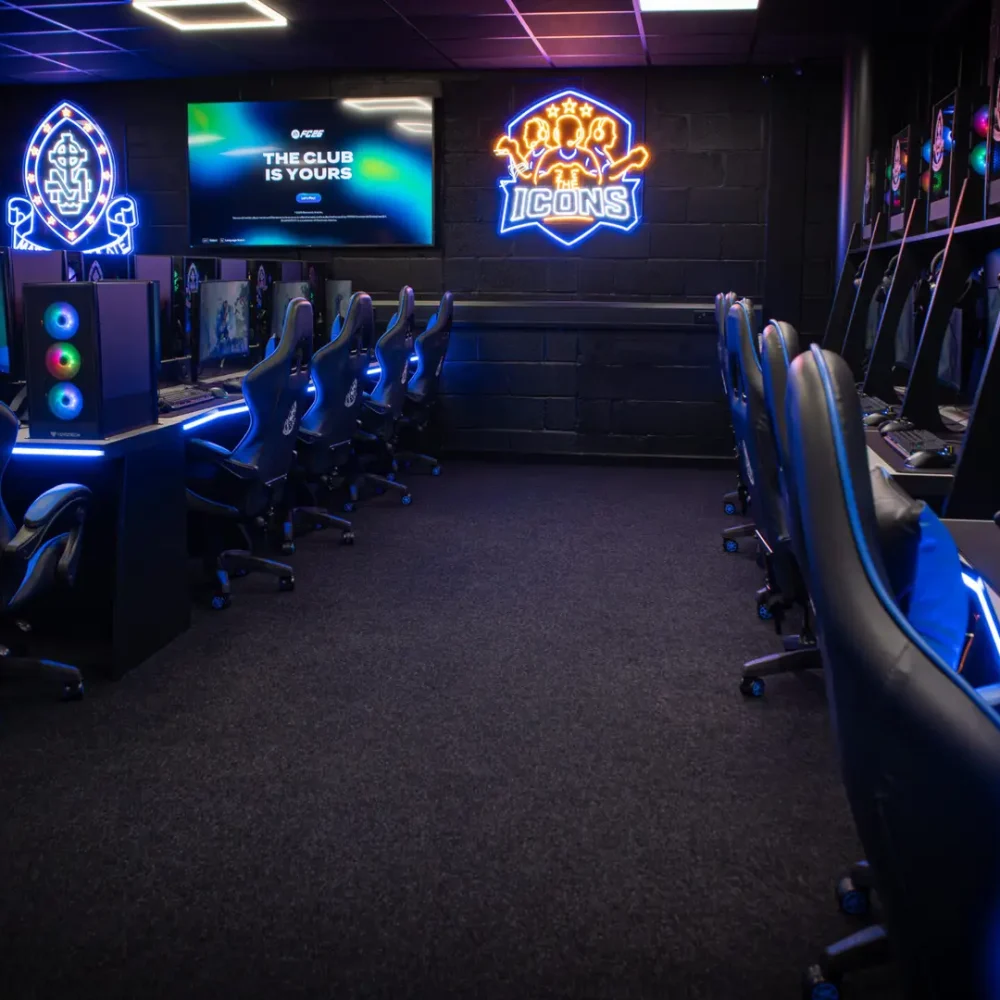
The first secondary school in Wales to install a facility of this calibre, backed by a £130,000 investment from Cardiff Council. We brought students into the design process from day one: the result includes custom neon signage for the school’s esports teams, height-adjustable desks for accessibility, and a bespoke feature desk that doubles as the teacher’s command centre.
Frequently Asked Questions
What is an esports arena?
A dedicated space for competitive gaming, teaching and broadcast, built with purpose-designed PCs, furniture and networking rather than adapted from a general-purpose classroom.
How much does an esports arena cost?
Costs scale with ambition. Our Mary Immaculate High School project came to £130,000; Coleg Cambria’s 36-station college arena cost £230,000. Individual competition-grade PCs are typically the biggest single cost driver.
Do schools need a dedicated arena, or will a standard IT room do?
A standard IT room can run esports sessions, but a dedicated arena gives students proper competition conditions and gives staff the network capacity and management tools a shared classroom isn’t built for. The clearest benefit institutions report is reaching students who don’t otherwise engage with traditional sport, alongside a genuine pull on open days.
How long does it take to build one?
Most projects run from design sign-off to a fully installed arena within a single term, though scope and any building work involved will affect that. We’ll give you a firm timeline once we’ve scoped your room.